
What Is a PMMA Skull Implant ?
Updated: Jan 21
Restoring skull symmetry after trauma or surgery is crucial for both protection and aesthetics. For 2026, advanced medical technology offers a superior solution. The modern PMMA skull implant provides a precise, safe, and cosmetically elegant way to rebuild cranial structure, enhancing a patient's quality of life. This guide explores how patient-specific implants are revolutionizing cranial reconstruction.
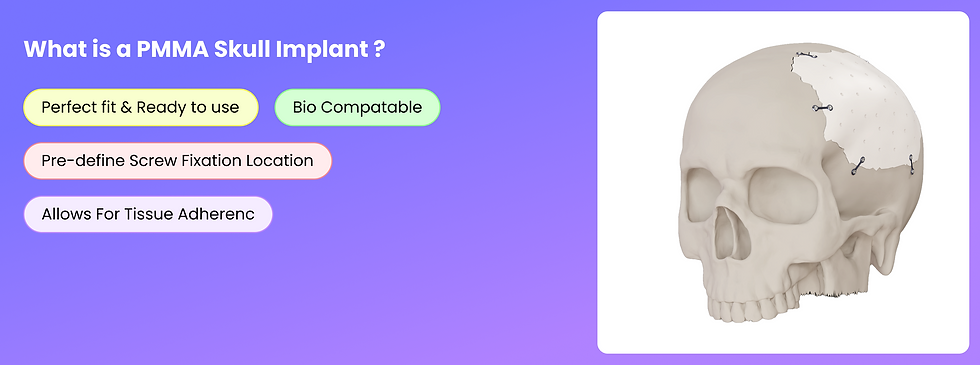
Understanding the Role of Customized PMMA Cranial Implants in Reconstruction
Cranial reconstruction has evolved significantly, moving from generic plates to highly personalized solutions. Customized PMMA Cranial Implants are at the forefront of this evolution, offering an unparalleled match to the patient's unique anatomy.
What is Polymethyl Methacrylate (PMMA) in Neurosurgery?
So, what is a PMMA skull implant? Polymethyl Methacrylate (PMMA) is a medical-grade polymer, often referred to as acrylic or bone cement, that has been a gold standard in neurosurgery for decades. Its chemical properties make it exceptionally suited for skull reconstruction due to its strength, biocompatibility, and malleability during the manufacturing process. At Cranioplastyflaps, we utilize only world-class certified Bio-Compatible PMMA, ensuring the highest standards of patient safety and material purity for every implant we produce.
Benefits of World-Class Certified Bio-Compatible PMMA
The material choice is fundamental to the success of a cranioplasty. Our use of world-class certified Bio-Compatible PMMA provides numerous advantages:
Proven Safety: The material has an extensive history of safe use within the human body, minimizing the risk of adverse reactions.
Superior Brain Protection: It offers robust protection against impact, safeguarding the brain while restoring the skull's natural barrier.
Improved Appearance: The implant precisely restores the original cranial contours, leading to excellent cosmetic outcomes.
Lightweight Nature: Compared to dense metals like titanium, PMMA is significantly lighter, improving patient comfort without compromising on strength.
The Cranioplastyflaps Approach to 3D Printed Skull Reconstruction
At Cranioplastyflaps, our mission is to leverage cutting-edge technology to perfect the process of 3D Printed Skull Reconstruction. We combine digital precision with medical expertise to deliver implants that are both functional and aesthetic.
Utilizing Complex Cranial Modeling Technology for Exact Symmetry
Achieving perfect symmetry is our primary goal. We achieve this through a sophisticated process involving Complex Cranial Modeling. Here’s how it works:
High-resolution CT scan data is converted into a detailed 3D digital model of the patient's skull.
Advanced software analyzes the cranial defect and uses the healthy, contralateral side as a perfect mirror image or reference.
This digital blueprint allows us to recreate the lost bone structure with sub-millimeter accuracy, ensuring the final custom PMMA skull implant preserves the patient's original aesthetics.
This application of Complex Cranial Modeling guarantees a result that is virtually indistinguishable from the natural skull.
Collaborative Design and Planning with Medical Experts
An implant is only as good as the surgical plan it supports. That's why our Collaborative Design service is integral to our process. We work directly with a multidisciplinary team of medical experts, including:
Neurosurgeons
Plastic Surgeons
Rehabilitation Specialists
Neuroradiologists
This approach of Collaborative Design and planning ensures every implant meets the precise surgical requirements and contributes to optimal medical and cosmetic outcomes for the patient.
Why Choose Patient-Specific Cranial Prostheses Over Traditional Methods
The shift towards Patient-Specific Cranial Prostheses marks a significant advancement over traditional, intra-operatively molded implants or pre-formed metal plates. The precision offered by custom solutions leads to better results and smoother procedures.
Variable Thickness and Pre-Defined Screw Fixation Locations
Unlike one-size-fits-all solutions, our Patient-Specific Cranial Prostheses are engineered with specific features to aid surgeons and improve outcomes:
Variable Thickness: The implant thickness is matched exactly to the surrounding bone, creating a seamless and natural transition.
Pre-Defined Fixation Points: Screw locations are strategically planned and marked on the implant, removing guesswork and reducing surgical time.
Superior Precision: This level of detail is impossible to achieve with intra-operative molding, which often results in less precise fits.
Ensuring a Perfect Fit with Advanced Digital Software
Each PMMA skull implant from Cranioplastyflaps is delivered to the operating room 100% ready for use. Our digital mapping process ensures a perfect anatomical match, preventing the gaps or uneven edges common with traditional methods. This precision is essential for correcting both simple and complex cranial deformities, restoring integrity and function to the skull.
Comparative Analysis: PMMA Skull Implant vs Titanium and Other Materials
When selecting a material for cranioplasty, several factors come into play. A Cranioplastyflaps PMMA skull implant offers distinct advantages over alternatives like titanium, particularly in post-operative monitoring and cost-effectiveness.
Radio-Opaque Properties: Clear Visibility Without Metal Artifacts
One of the most significant benefits of our implants is their Radio-Opaque Properties. This means they are visible on scans without causing the significant signal distortion, or 'artifacts', that titanium plates produce. Clear visibility in post-operative CT and MRI scans is crucial for long-term patient monitoring. The superior Radio-Opaque Properties of our material ensure that neuroradiologists get a clear view of the brain.
Feature | PMMA Implant | Titanium Implant |
Scan Artifacts | Minimal to none | Significant metal artifacts |
Brain Visibility (Post-Op) | Clear and unobstructed | Obscured near the implant |
Long-Term Monitoring | Ideal | Challenging |
Cost-Effectiveness of PMMA Solutions for Cranioplasty
A Cranioplastyflaps PMMA skull implant also presents a more cost-effective solution without compromising quality. The primary savings come from a reduction in surgical time, as the ready-to-use implant eliminates the need for intra-operative shaping and fitting. Our streamlined approach to creating a custom PMMA skull implant makes advanced care more accessible.
Cost Factor | Patient-Specific PMMA Implant | Traditional Methods (Molding/Titanium) |
Surgical Time | Reduced | Increased (due to shaping) |
Material Cost | Cost-effective | Often higher, especially for titanium |
Waste | None (pre-fabricated) | Material waste from molding |
Safety, Sterilization, and Post-Operative Outcomes with a PMMA Skull Implant
Patient safety is the final and most important piece of the puzzle. From manufacturing to post-operative recovery, every step is designed to ensure the best outcome for the patient receiving a PMMA skull implant.
ETO Sterilization Compatibility and 100% Readiness for Use
Our Customized PMMA Cranial Implants are fully compatible with Ethylene Oxide (ETO) sterilization, a standard and trusted method in medical facilities. The implant arrives at the hospital ready for the surgical workflow, ensuring it meets the highest hygiene and safety protocols without causing delays.
Promoting Tissue Adherence and Reducing Pain
A well-fitted PMMA skull implant integrates better with the body. The precise fit allows for improved tissue adherence, which promotes healing and long-term stability. This perfect fit, combined with the material's properties, contributes to reduced post-operative pain and a higher quality of life. This dedication to excellence is what defines our 3D Printed Skull Reconstruction service.
Getting Started with Cranioplastyflaps Solutions
Partnering with Cranioplastyflaps to provide your patients with superior cranial reconstruction solutions is a straightforward process:
Contact Our Team: Reach out with the case details and requirements.
Submit Scan Data: Securely upload the patient's high-resolution CT scan data.
Collaborate on Design: Our experts will work with your surgical team to finalize the implant design.
Receive the Implant: The final, sterile-ready implant is delivered directly to your facility.
We combine Complex Cranial Modeling, Collaborative Design, and superior Bio-Compatible PMMA to produce the best Patient-Specific Cranial Prostheses. Our unique material offers excellent Radio-Opaque Properties, and the result is a perfect 3D Printed Skull Reconstruction solution. The future of cranioplasty is the patient-specific PMMA skull implant.
Frequently Asked Questions
What makes Cranioplastyflaps PMMA implants different from standard stock implants?
Our implants are created from a patient's specific CT scan, ensuring a perfect anatomical fit that stock implants cannot match.
How long does the collaborative design process take?
The process is typically completed within a few business days, depending on the complexity and surgeon availability for review.
Does the PMMA material interfere with future CT or MRI scans?
No, it produces minimal to no artifacts on CT and MRI scans, allowing for clear visibility of the brain for future monitoring.
What is the full form of PMMA implant?
The full form of PMMA is Polymethyl Methacrylate.
Which material is best for cranioplasty?
The best material depends on the case, but PMMA is often preferred for its biocompatibility, strength, radiolucency, and cost-effectiveness.
Are there any disadvantages to PMMA?
Potential disadvantages can include lower strength than titanium and a risk of infection, though these are minimized with custom fitting and proper surgical technique.


Comments